The Value of Long-Term Thinking
February 19, 2026
After years of education and paying attention to how various financial institutions will use framing effects – the purposefully chosen positioning of facts – in order to support their chosen narratives. Here’s a short exercise in how to make sure your facts are supporting your goals.
Position One – Schwab’s US Outlook
Charles Schwab is a US company whose largest business is Discount Brokerage – standard DIY investors. DIY investors as a class often trade much more often than institutional investors. Schwab makes money when money moves – as people trade, they pay commissions. More important to their business – as people trade, Schwab also has the right to use that trading information to support decision making for their own mutual funds.
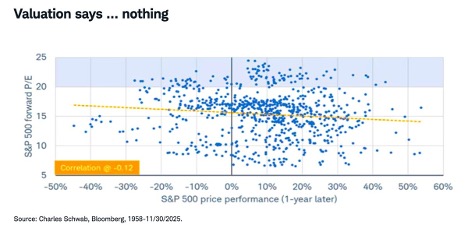
Schwab has chosen to use short-term thinking to support their annual US Stock Market Outlook by using the historical 1Y price performance of the S&P500 compared to forward-looking valuations.
See, DIY Investors, valuation in the short run is meaningless! Trade away!
 (source)
Position Two – Apollo’s US Outlook
Apollo Global Management is a Private Equity, Private Credit, and Alternatives investment giant with nearly $1T in assets-under-management. These assets are primarily from sovereign wealth funds, endowments, and pension funds. Apollo makes money by not losing money for their investors over very long periods of time.
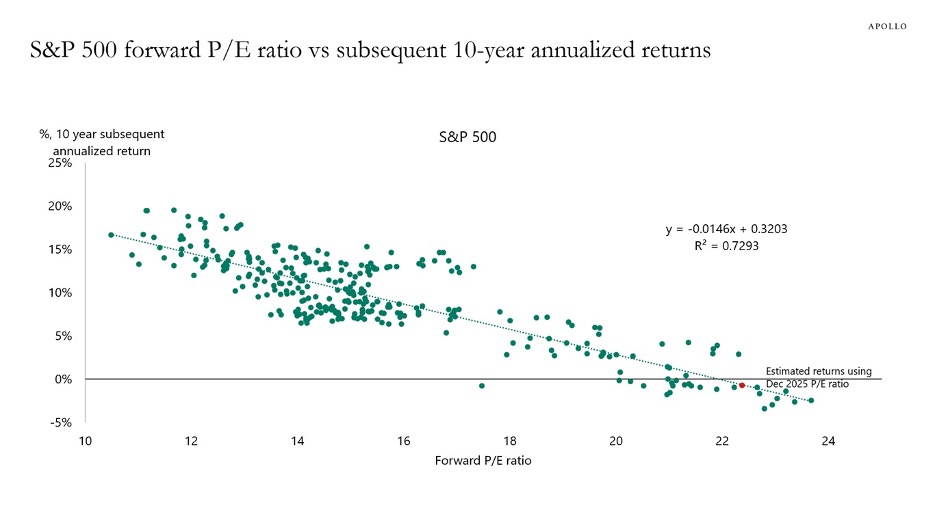
Apollo has chosen to use long-term thinking to support their annual US Stock Market Outlook by using the historical 10Y price performance of the S&P500 compared to forward-looking valuations.
The little red dot on this chart below show’s that Apollo is paying close attention to the fact this market is not in “set it and forget it” mode right now, with the expected 10Y return now in negative territory.
 (source)
Two completely factual charts; two entirely different takeaway messages.
As a portfolio manager focused on making evidence-based decisions over long-term time periods, my job is to help investors choose a factual narrative that supports their goals and protects them against short-term thinking.