Why I’m Still Positive on Markets
August 7, 2026
Markets are back near all-time highs, which naturally makes people nervous. But I actually think the market looks healthier today than it did a month or two ago.
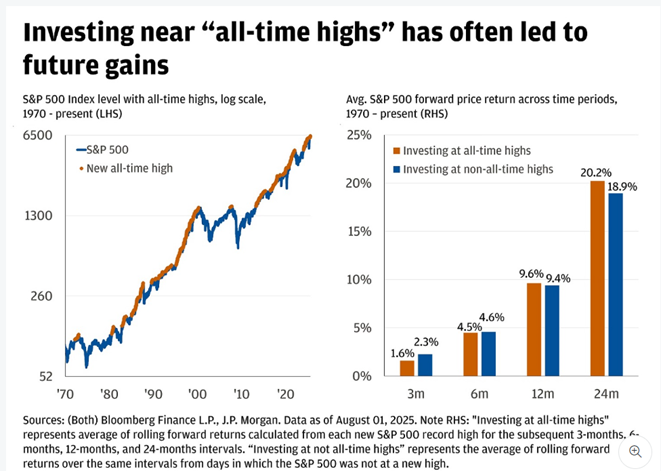
• All-time highs aren’t a reason to sell. This sounds counterintuitive, but history is quite clear. Since 1970, the S&P 500 has produced an average return of 9.6% in the 12 months following an all-time high — slightly better than the 9.4% average return following all other days. Over the following two years, the average return after an all-time high was 20.2%. New highs have historically been a characteristic of rising markets, not a signal that they are about to end.
• The rally is getting much broader. This is probably what makes me most comfortable/bullish. Since the June high, roughly two-thirds of S&P 500 companies have risen and 8 of 11 sectors have advanced. The equal-weight S&P 500, which gives every company the same importance, gained almost 4% while the traditional S&P 500 fell about 2.4%. That is a much healthier market than one being carried by only a few giant technology companies.
• S&P 500 is reporting the highest net profit margin in more than 15 Years. FactSet currently estimates the S&P 500 Q2 net profit margin at 15.7%, potentially the highest since FactSet began tracking it in 2009. That gives the rally a strong fundamental underpinning.
• Markets are becoming less sensitive to every tariff or Trump headline. Last year, almost every tariff announcement would move markets sharply. Today, investors appear more willing to wait and see what actually becomes policy. Trump’s reputation to “cry wolf” is being recognized— lots of threats but lesser bark.
• Iran is another example of why geopolitical risk may be becoming less of a market driver. Both sides have already gone after much of the “low-hanging fruit,” making obvious targets harder to find. At the same time, some of Iran’s most secure nuclear-linked infrastructure, including facilities are believed to be buried deep inside Pickaxe Mountain, is extremely difficult to destroy.
That means simply continuing the conflict may not accomplish the original objectives, while the costs keep rising (financially and politically) . Both sides increasingly have reasons to look for an off-ramp.
The situation isn’t solved, but it may be becoming more predictable — and markets generally handle “less bad” much better than escalating uncertainty.
• The world is also adapting. Saudi Arabia has already redirected crude through pipelines to the Red Sea and used alternative shipping routes. The more Iran uses Hormuz as leverage, the greater the incentive for the rest of the world to develop alternatives. That doesn’t eliminate the risk, but over time it can reduce its economic impact.
That last point is important: geopolitical problems don’t necessarily need to be “solved” for markets to move higher. Russia hasn’t been solved. China-U.S. tensions haven’t been solved. Tariffs haven’t disappeared.
Things simply have to become less bad — or more predictable.
And compared with a couple of months ago, I believe that is increasingly what we are seeing.
One final point on optimism
People sometimes think of me as overly optimistic. I don’t see it that way. I try to call balls and strikes. I look at the data, I look at history, and when I think optimism is overdone, I’ll say so. When I think pessimism is overdone, I’ll say that too.
But there is an important reality investors should remember: in general, people overestimate the accuracy of doomers and underestimate the accuracy of optimists — and it costs them.
Pessimism sells. Doom-and-gloom predictions get attention because they sound urgent and intelligent. Someone warning that something terrible is about to happen can seem like they are protecting us from a danger everyone else has missed.
Optimism is a harder sell. Saying that the economy will adapt, businesses will continue to innovate and markets will eventually work through their problems can sound almost simplistic.
But history has overwhelmingly been on the side of long-term optimists.
That doesn’t mean ignoring risks. It means putting those risks into perspective. Markets have lived through wars, recessions, inflation, financial crises, political turmoil and countless predictions that “this time is different.”
Yet businesses adapt, economies adjust and markets have continued to grow over time.
So when I’m positive today, it isn’t because I’m ignoring what could go wrong. It’s because I’m weighing what could go wrong against what is actually happening — and right now I think the evidence remains more positive than the headlines would suggest.
Mark Ting, CFP®, CIM® is a registered Portfolio Manager at Foundation Wealth Partners. Foundation Wealth Partners LP (“FWP”) is registered as a Portfolio Manager and Exempt Market Dealer in all Canadian provinces and the Yukon territory.
Foundation Wealth Partners LP (“FWP”) is registered as a Portfolio Manager and Exempt Market Dealer in all Canadian provinces and the Yukon territory.
This material is distributed for informational purposes only and is not intended to provide personalized legal, accounting, tax, or specific investment advice, nor does it constitute a recommendation or an offer to buy, hold, or sell any financial products. The information is not tailored to any investor’s circumstances. Please speak to a Foundation Wealth Partners advisor regarding your unique situation. Past performance is not indicative of future results; any statements that are predictive in nature are not guarantees of future performance. For more information, please visit Disclaimer & Terms of Use