Wednesday’s Euphoria, Thursday’s Panic. What Changed?
November 6, 2026
Last week on CBC, I made a few predictions about the U.S. midterms (can be heard here) . I thought it would be fun to see how well they aged. Based on prediction markets data, I expected a Democratic sweep, though the Democrats did even better than expected. I also said investors were worried that a stronger Democratic presence in Washington would mean tougher scrutiny of AI and data centres. As AI has done much of the heavy lifting for the stock market over the past couple of years, helping push it to dozens of new all-time highs. If that spending slows, some of those gains could unwind and stocks may struggle to keep rising at the same pace.
I thought the fear that AI spending would come to a screeching halt was overblown, and I still do. There’s a bipartisan interest in keeping the industry going as AI investment is currently one of the biggest drivers of U.S. economic growth. I expect more conditions on how and where data centres get built, and a more measured pace of spending. I think that could cause some volatility but be good overall for both the market and the economy.
With most of my predictions playing out, I’d give myself a B+. The call I got wrong was saying that the day after the election would be a non-event. Instead, stocks rallied hard on Wednesday, then plunged on Thursday. AI stocks led the sell-off, and every sector fell. However, by Friday morning (as of 9 a.m.), many of those same AI stocks are bouncing back.
My read is that investors are still figuring out what the election results mean for AI spending. I didn’t see anything between Wednesday and Thursday that warranted such a sharp swing from euphoria to fear. There was no major policy announcement, the war hadn’t escalated, and tariffs were still in place.
If markets settle down over the next few days, I wouldn’t be surprised if we end up back where we were before the election. Maybe my non-event call was just a few days early.
Why we don’t make emotional decisions based on politics
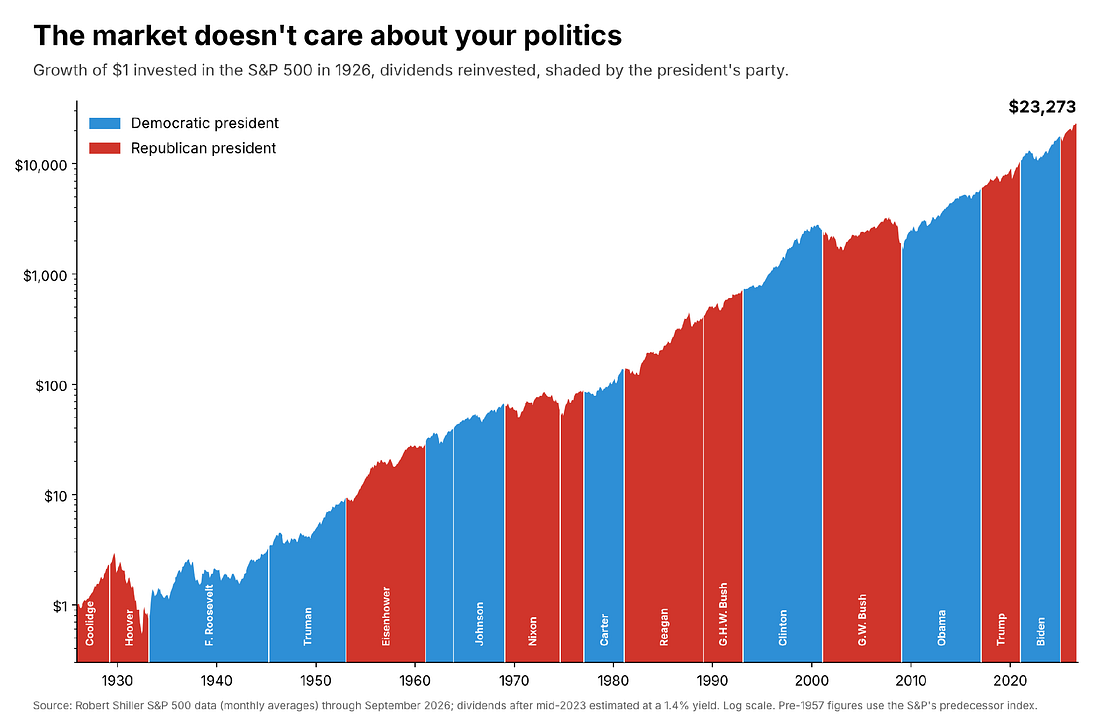 Half the country is celebrating, and the other half is mourning . But investors shouldn’t be too afraid: as I have previously stated, the S&P 500 has risen in the 12 months after every midterm since 1946 (by an average of about 15%).
Historically, a divided government has been a strong setup for investors. As such, we don’t let election day results skew our views. Over time it is the earnings, interest rates and innovation that matter far more than who holds power.
The Rotation Continues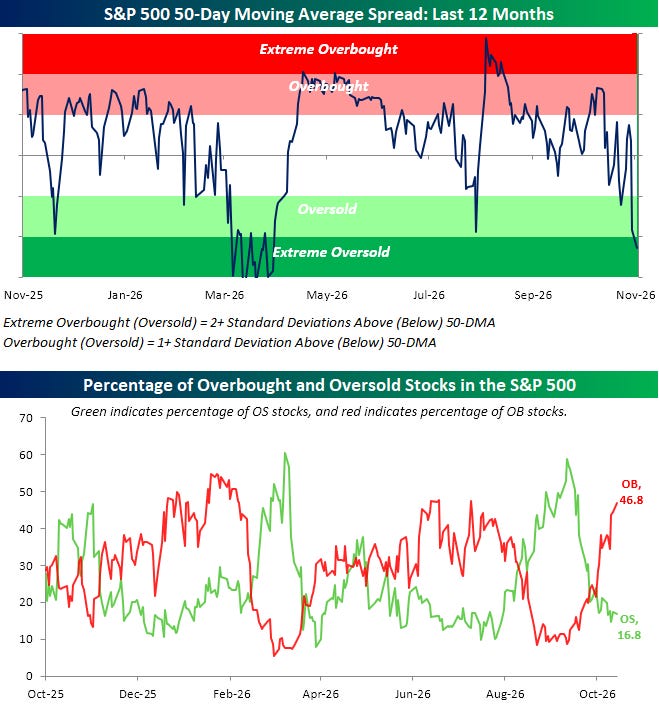 (Bespoke Investment Group: @bespokeinvest)
The S&P 500 is deeply oversold, trading more than two standard deviations below its 50-day average. Yet nearly half its stocks are overbought, and only 17% are oversold. Bespoke Investment Group called the combination one of the most unusual it’s ever seen.
A handful of the index’s biggest stocks are falling hard enough to pull it down while many others are holding up. To me, that looks like a rotation. Investors are pulling money out of the crowded AI trade, and plenty of stocks elsewhere are still finding buyers.
Yet tech hasn’t been this cheap since 2022?
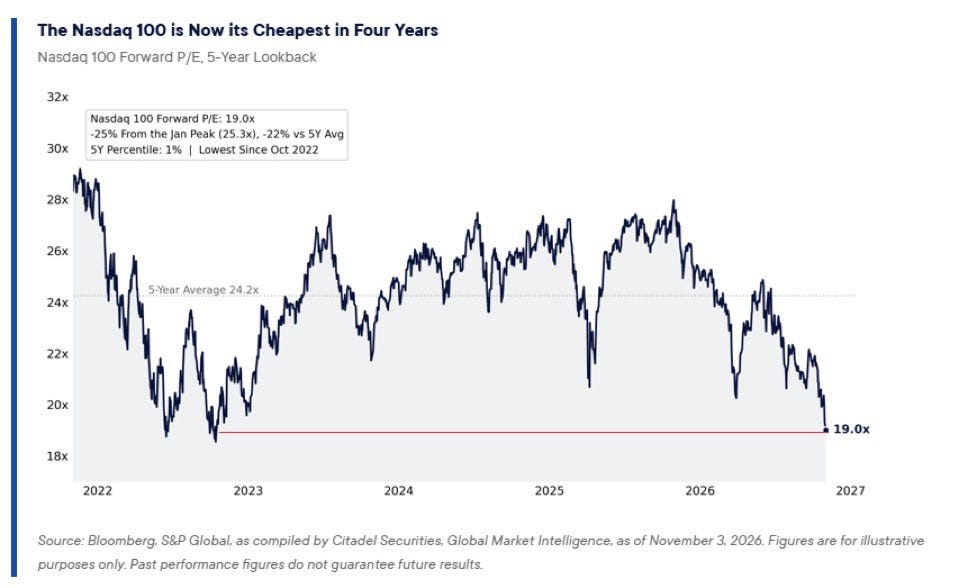
The sell-off has made Big Tech cheaper relative to expected earnings. The question is whether those earnings will hold up (this is the main variable the market is grappling with). AI spending is squeezing free cash flow, and with the U.S. 10-year Treasury yield still near 5%, investors have good reason to be picky about what they pay.
The next big test is November 17, when Nvidia reports earnings. I’ll be watching what it says about demand for AI chips in the months ahead.
My final words on the election and recent volatility
Here’s what I care about as an investor. Republicans and Democrats are both addicted to spending and borrowing. The midterms may change where Washington spends the money, but I doubt they’ll change its appetite for spending. When the Fed adds liquidity, that generally helps support stocks and other assets. That’s the idea behind the debasement trade. If inflation keeps chipping away at the purchasing power of cash, I want to own businesses that can grow their earnings, along with assets like productive land and gold.
Bottom line: All you have to do is stay invested and let the politicians, Federal reserve, and Treasury do the heavy lifting for you. Don’t overthinking what’s about to happen. Simply follow the capital flows and the policies. If the new leadership politically is supporting things like healthcare, those companies should benefit. If that same leadership is against a certain industry, then it will likely struggle.
Politicians can slow innovation down and set tougher rules, and sometimes that’s a good thing. But when people want better products/experiences, companies find a way to deliver it. In the long run, technology wins out over politics, and consumers are better off for it.
Mark Ting, CFP®, CIM® is a registered Portfolio Manager at Foundation Wealth Partners. Foundation Wealth Partners LP (“FWP”) is registered as a Portfolio Manager and Exempt Market Dealer in all Canadian provinces and the Yukon territory.
Foundation Wealth Partners LP (“FWP”) is registered as a Portfolio Manager and Exempt Market Dealer in all Canadian provinces and the Yukon territory.
This material is distributed for informational purposes only and is not intended to provide personalized legal, accounting, tax, or specific investment advice, nor does it constitute a recommendation or an offer to buy, hold, or sell any financial products. The information is not tailored to any investor’s circumstances. Please speak to a Foundation Wealth Partners advisor regarding your unique situation. Past performance is not indicative of future results; any statements that are predictive in nature are not guarantees of future performance. For more information, please visit Disclaimer & Terms of Use