More Tricks Than Treats: A Difficult Week for Markets
October 30, 2026
It's been a difficult week for financial markets, particularly for technology stocks. And with Halloween upon us, investors have been given plenty to worry about: rising oil prices, higher interest rates, disappointing technology earnings, geopolitical tensions and the upcoming U.S. midterm elections.
That's quite a list. But while there's reason for caution, I don't think the underlying economic picture is nearly as negative as the headlines suggest.
This may be less about investors abandoning stocks and more about money rotating from one part of the market into another.
The AI Trade Is Showing Some Cracks
One of the biggest stories this week has been the weakness in technology stocks. Companies that have driven much of the market's gains are suddenly facing greater scrutiny.
Alphabet experienced a particularly difficult week, with shares falling nearly 13% in a single session. Amazon and Intel have also come under pressure following disappointing earnings reports and outlooks.
Companies continue to spend enormous amounts building AI infrastructure, including data centres, advanced computer chips and the electricity needed to power them.
Investors have supported this enormous spending on AI infrastructure based on expectations of substantial future profits. But they're once again questioning whether those profits will materialize quickly enough to justify the investment. To me, it feels like déjà vu. The AI “bubble” seems to be constantly inflating and deflating as investor sentiment swings between excitement and skepticism.
Oil Has Become a Bigger Problem
The other major development is the continued rise in oil prices.
Brent crude has climbed above $110 per barrel, driven largely by conflict in the Middle East and concerns about further escalation involving Iran.
Higher oil prices have a complicated effect on the economy.
They benefit energy producers, including many Canadian companies. But higher energy costs also affect transportation, manufacturing, food prices and household budgets.
Higher oil prices are effectively another tax on consumers and that creates a dilemma for central banks.
Higher energy costs push inflation upward, potentially encouraging central banks to raise interest rates. But those same costs can eventually slow economic growth.
The key question is whether oil prices stabilize. If tensions ease and oil retreats, pressure on inflation and interest rates could disappear surprisingly quickly.
Interest Rates Are Back in Focus
This week was particularly important for central banks.
The Bank of Canada increased its benchmark interest rate by 0.25 percentage points to 2.5%, its first increase in more than three years.
The Federal Reserve held rates steady at 3.75% to 4%, although two policymakers voted for an increase. The European Central Bank and Bank of Japan left rates unchanged.
The common concern is inflation, particularly higher energy prices.
Canada's situation is particularly interesting because our economy isn't performing nearly as well as the American economy.
Canadian GDP was unchanged in August, and preliminary estimates suggest a small contraction in September. Third-quarter growth is tracking at approximately 1.3% annualized.
Yet the Bank of Canada has raised rates over concerns that higher energy costs could lead to persistent inflation.
This creates challenges for borrowers, particularly those renewing mortgages or carrying variable-rate debt.
For investors, bond yields also deserve attention. With the U.S. 10-year Treasury yield around 5%, bonds are providing meaningful income, although further rate increases could put pressure on bond prices.
The U.S. Economy Is Still Surprisingly Strong
With all the negative headlines, it's easy to overlook one of the more encouraging developments this week.
The U.S. economy grew at an annualized rate of 3.4% in the third quarter.
Consumer spending remains resilient, while business investment continues to benefit from enormous spending on AI infrastructure.
That's hardly an economy falling apart.
Inflation remains elevated, and higher prices are squeezing household purchasing power. But the economy continues to demonstrate an impressive ability to absorb these challenges.
A difficult week for the stock market doesn't necessarily mean we're heading into a difficult period for the economy.
And that brings us back to market rotation.
If investors become less enthusiastic about paying high valuations for technology companies, that money doesn't just disappear. Much of it moves into businesses with more reasonable valuations, stronger cash flows or those benefiting from current economic conditions.
Energy is an obvious example, while financial companies and traditional businesses could also attract greater attention.
And Then There Are the Midterm Elections
Next Tuesday, Americans head to the polls for the midterm elections.
Elections naturally create uncertainty, particularly when the outcome could change control of Congress and government policy.
But here's a statistic I find particularly interesting (discussed in more detail in my last client letter)
Since 1950, there have been 19 U.S. midterm elections. In every instance, the S&P 500 was higher six months later.
Nineteen elections. Nineteen positive returns.
BlackRock also found that the average six-month return following midterms since 1970 was 14.1%, compared with 5.7% over comparable periods in years without midterm elections.
Historical results don't guarantee future performance, but there's a reasonable explanation for this pattern.
Markets tend to dislike uncertainty more than any particular political outcome. Once an election is over, investors have a clearer understanding of the political landscape and can focus on what comes next.
Whether Democrats or Republicans control Congress may matter for individual industries, but corporate earnings, economic growth and interest rates are generally more important drivers of long-term returns.
The immediate market reaction could go either way, particularly with geopolitical tensions unresolved. But history suggests investors should be careful about allowing politics to dictate investment decisions.
What Does This Mean for Our Portfolios?
As you know, we're not ones to panic when markets become volatile. Technology stocks have taken a hit, but does that mean we're abandoning our positions? Absolutely not. In fact, we'll be looking to add to some of these holdings through our regular weekly rebalancing.
I continue to believe technology represents one of the greatest long-term investment opportunities. But lumping everything together as the "AI trade" is a mistake. There are many different businesses within technology, each with its own opportunities and challenges.
I recently watched a presentation by Fidelity portfolio manager Mark Schmehl, whose Global Innovators strategy (a core holding in the Foundation Wealth Equity Pool) has significantly outperformed the Nasdaq this year (45.48% vs 17.02% as of Oct 29th). One area he's particularly interested in is cybersecurity, where he sees substantial growth opportunities as companies will need to invest in stronger, faster and more secure digital infrastructure.
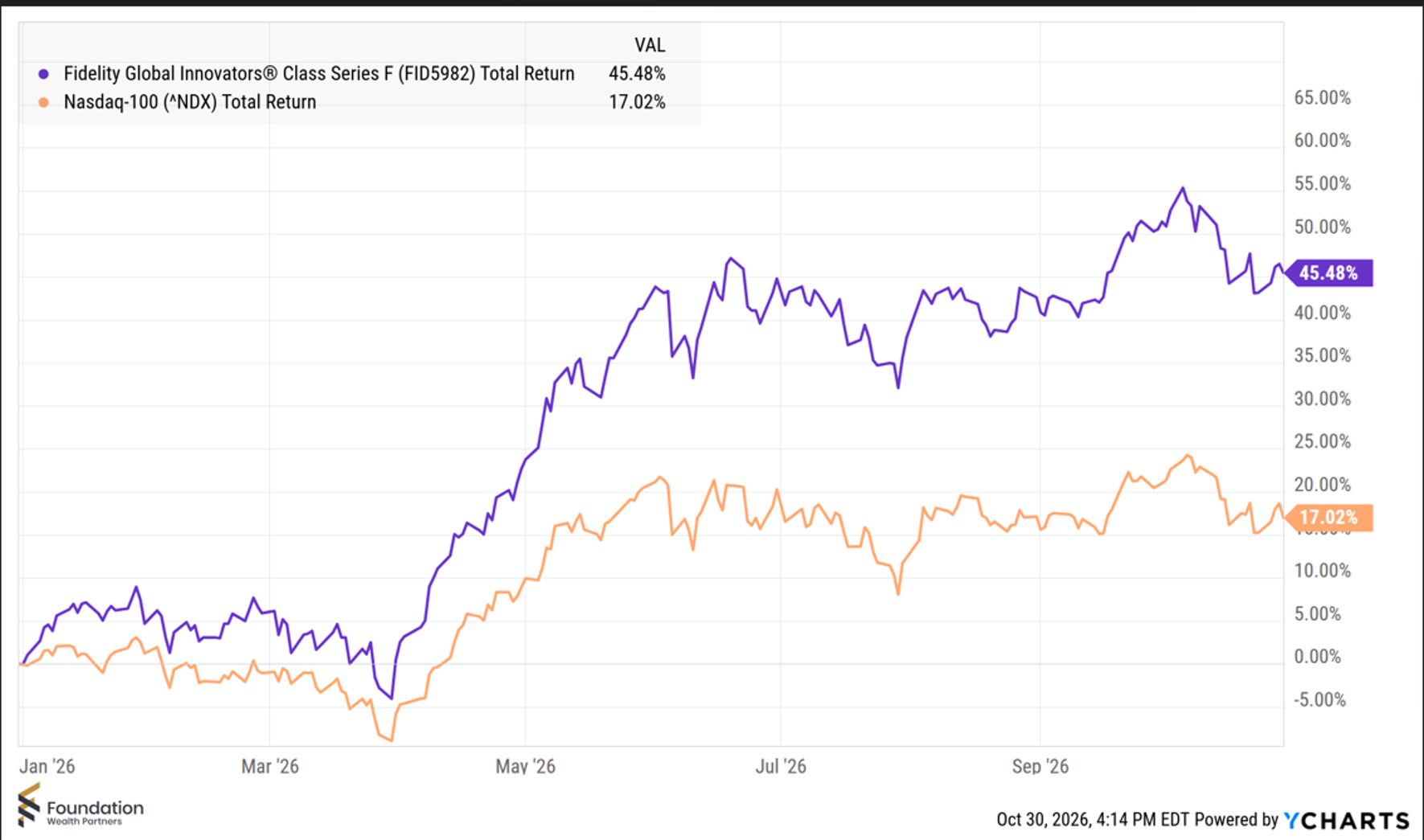
It's a good reminder that even within technology, new opportunities are constantly emerging.
Our approach remains the same: stay diversified, manage risk and take advantage of opportunities when markets become overly pessimistic.
Mark Ting, CFP®, CIM® is a registered Portfolio Manager at Foundation Wealth Partners. Foundation Wealth Partners LP (“FWP”) is registered as a Portfolio Manager and Exempt Market Dealer in all Canadian provinces and the Yukon territory.
Foundation Wealth Partners LP (“FWP”) is registered as a Portfolio Manager and Exempt Market Dealer in all Canadian provinces and the Yukon territory.
This material is distributed for informational purposes only and is not intended to provide personalized legal, accounting, tax, or specific investment advice, nor does it constitute a recommendation or an offer to buy, hold, or sell any financial products. The information is not tailored to any investor’s circumstances. Please speak to a Foundation Wealth Partners advisor regarding your unique situation. Past performance is not indicative of future results; any statements that are predictive in nature are not guarantees of future performance. For more information, please visit Disclaimer & Terms of Use