It's a Rotation, Not a Retreat
October 16, 2026
This week, it looks like we are seeing a rotation within the stock market. Investors are taking profits in some of the technology companies that have performed well and moving toward more traditional businesses associated with the Dow. This looks less like a rush to the sidelines and more like a reassessment of where the next opportunities lie.
Yesterday provided an example. The TSX gained 1.55%, while the S&P 500 rose 0.33%. Even the Nasdaq recovered from an earlier decline of as much as 1.4% to finish slightly higher. There was selling in parts of the market, but buyers were willing to put money to work elsewhere.
Over the past few months, the character of the market has shifted. Earlier, gains were broadening across more companies and sectors, which is generally what I prefer. As inflation and interest-rate concerns resurfaced, what I noticed was more concentrated leadership. A handful of the largest stocks were doing much of the heavy lifting, allowing the major averages to rise without the typical company participating to the same extent (which isn’t ideal).
Now, we appear to be moving back toward broader participation. Investors are trimming technology exposure and buying more traditional businesses. I view that as positive. A market supported by several sectors has a healthier foundation than one relying on the same small group of companies to keep exceeding high expectations.
Much of the daily back-and-forth reflects markets trying to find their footing around inflation and interest rates. Stronger inflation figures can increase expectations for rate hikes, while central-bank comments can soften those expectations. This is nothing new. Markets continually adjust prices as information changes.
Will Diplomacy Bring Relief at the Pump?
On the war, Washington’s push to lower diesel prices ahead of the midterms may help, but additional Russian supply may offer only limited relief. The more important question is whether diplomacy can reduce attacks on refineries and keep fuel moving. A Saudi-Houthi agreement could help, although a broader agreement with Iran remains uncertain.
I see room for cautious optimism, but announcements alone won’t solve the problem. The real test is whether these efforts lead to fewer disruptions and more reliable fuel supplies. That would be welcome news for businesses and consumers, while helping ease some inflation pressure.
19 Midterms. 19 Gains. What Happens This Time?
Looking ahead, the U.S. midterms should remove another source of uncertainty. The result matters for individual policies and industries, but markets can work with either party in power. Often, investors simply want to know the outcome so they can assess what comes next.
This is where the numbers get interesting. Schaeffer’s Investment Research found that the S&P 500 finished higher six months after all 18 midterm elections from 1950 through 2018.
The 2022 election extended that streak. Using S&P 500 closing prices published by the Federal Reserve Bank of St. Louis, the index gained approximately 8.1%, excluding dividends, between November 8, 2022, and May 8, 2023. That brings the completed record to 19 out of 19—positive 100% of the time.
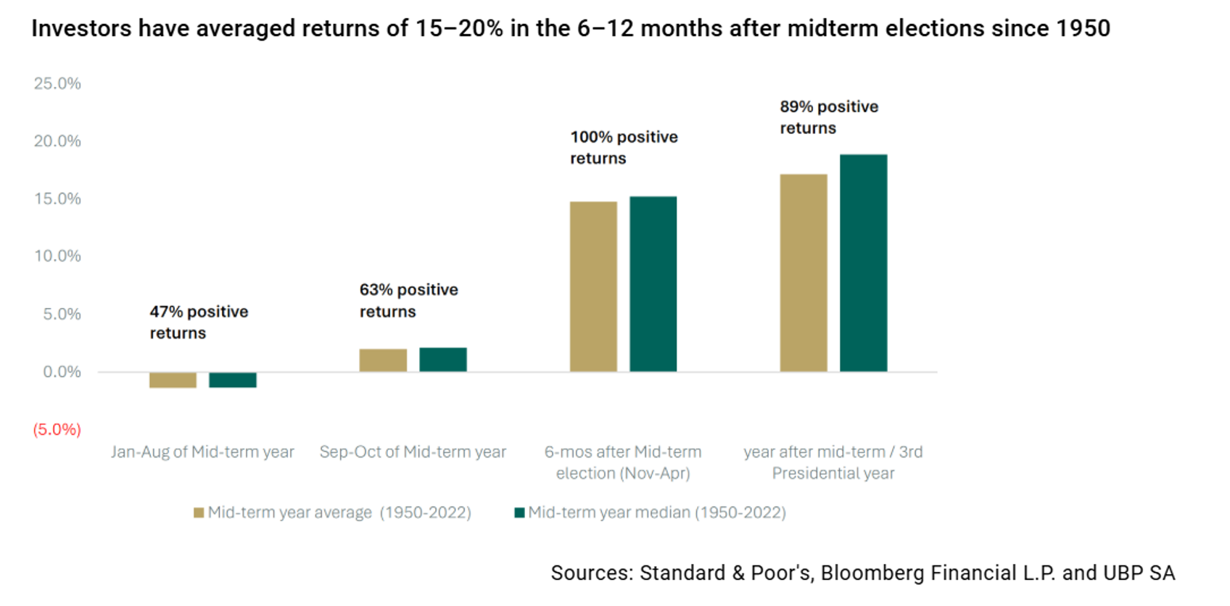
Separately, BlackRock’s analysis covering midterms from 1970 through 2022 found an average six-month total return of 14.1%, compared with 5.7% over equivalent periods in non-midterm years. It also found that the rally historically began approximately one month before election day.
There are no guarantees. Nineteen elections remain a small sample, and finishing higher six months later does not mean avoiding declines along the way. Nevertheless, that consistency is unusual and provides a compelling historical backdrop.
My takeaway is cautiously positive. Investors appear to be changing what they own rather than giving up on stocks, and I’d welcome a sustained move toward broader participation. The post-midterm record adds another reason for optimism, even if the next few weeks remain choppy. I would rather see more companies sharing in the gains than rely on the same handful of winners to carry the market.
Mark Ting, CFP®, CIM® is a registered Portfolio Manager at Foundation Wealth Partners. Foundation Wealth Partners LP (“FWP”) is registered as a Portfolio Manager and Exempt Market Dealer in all Canadian provinces and the Yukon territory.
Foundation Wealth Partners LP (“FWP”) is registered as a Portfolio Manager and Exempt Market Dealer in all Canadian provinces and the Yukon territory.
This material is distributed for informational purposes only and is not intended to provide personalized legal, accounting, tax, or specific investment advice, nor does it constitute a recommendation or an offer to buy, hold, or sell any financial products. The information is not tailored to any investor’s circumstances. Please speak to a Foundation Wealth Partners advisor regarding your unique situation. Past performance is not indicative of future results; any statements that are predictive in nature are not guarantees of future performance. For more information, please visit Disclaimer & Terms of Use